Welcome to Scrimshaw.com – on the net since 1998!
Would you like to know more about the artform called scrimshaw? From How-To’s to Mystery Artists, to today’s practicing scrimshanders, you can find just about everything about scrimshaw here.
For those who want to try their hand at scrimshaw, we have an excellent picture of a lighthouse, one of the perennial requests when it comes to the art. We’ve created a pdf so you can print it out then choose your size, plus at the bottom there is a large size image for reference. See https://www.scrimshaw.com/lighthouse-point-scrimshaw-patterns-template/ for more information and a link to the pdf. I want to thank Chris Amelung again for putting this up as a creative commons photo, and his gracious email when I asked him if I could use it in my beginner’s scrimshaw book
Mystery Artist Found!
(actually the Mystery Artist found us!) See Mystery Artist #3 for more! We get requests rather frequently for identifying scrimshaw artists. Once in awhile the actual artist writes back, other times those who know or knew them will help us out. It’s a great community.
How can we help you?
We have a newsletter that is published bi-weekly through the spring, monthly during the summer and often weekly during the fall and winter. It’s free, fact filled and has a lot of information that doesn’t appear on the site, as well as a lot of scrimshaw patterns, questions answered and more. Sign up to get the articles first and stay up to date on what’s happening in the world of scrimshaw.
Scrimshaw.com shows scrimshaw on eco-friendly and other materials. We hope you find your visit enjoyable and educational. The origin of the word Scrimshaw is uncertain, but we know that this art has been practiced since revolutionary times. It did not, however, receive wide spread recognition until President John F. Kennedy, an enthusiastic collector, brought scrimshaw to the public eye. The American Whaling Fleet has ceased to exist. However, this art is being carried on by a few American artisans.
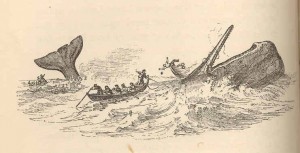
 Scrimshaw is the indigenous art form of the American Whaleman. In his idle hours of cruising for whale, he devoted himself to fashioning articles and jewelry of whale ivory. Today, the ivory trade is in turmoil with some states even banning mammoth ivory, confiscating musical instruments and mummies and antiques.
Here at scrimshaw.com, we are constantly searching for alternatives. One of which is a nut palm (also called “vegetable ivory”) which polishes to an incredible likeness of ivory, and whose hardness and durability rivals that of ivory as well. There are also other resources, such as fossilized ivory, antler (which drop off every year – if you can get them before the raccoons do!), and more. Calling scrimshaw done on powder horns scrimshaw is sometimes debated, since it was not done on whale bone by sailors. The technique is the same, and a lot of the artwork created ranges from stunningly photo-realistic to old world “folk art”. Some artists like to scrimshaw maps or quarry on their powderhorns, while others like to create personalized lettering or portraits. To us, it is still scrimshaw: painstakingly scribing images on any material and filling in the lines with some type of pigment is an artform that is not for the impatient. If you are a Scrimshander and would like to show your work here, I’d be more than happy to provide links to your site for free. Simply contact me at questions@scrimshaw.com
Hello! I have a scrimshaw whale tooth and would like to identify the artist. It is a picture of a sailboat (3 masts) with 2 whales and a small row boat. There appears to be a signature that could be “Pimente” or “Pimentel” or “Rimentes.” Would love help identifying!
Hi Eliza,
I’d love to see some pictures and put them up on the “Mystery Artists” page. Send pics if you can, including a picture of the signature to questions@scrimshaw.com.
Thanks!
Andrew
Good morning! I have a scrimshaw pendant that was purchased in Alaska in the 1960s. It is signed NUNUK. I would love to sell it but have no idea where to start. Can you help?
Hi Kathi, a group on FB called The Scrimshaw Collectors Guild (https://www.facebook.com/groups/scrimshawcollectorsguild/) may be able to help you. They’re a good group of people.
I have a fossilized walrus tusk with scrimshaw done by Mary Mueller. Do you have any way to contact/communicate with her so I can obtain information, etc.? My attempts to reach her have been unsucessful to date. Any assistance would be greatly appreciated.
Jim
Hi Jim,
I’m not sure how else to contact her, though you may want to reach out to https://www.arcticspiritgallery.com/mary-mueller/ and see if they could forward your request to her.
I draw quite a lot and have been interested to attempting the art of scrimshaw. I would like very much to receive your newsletter, purchase one of your scribes and anything else you recommend that I will need. Thank you!
Sincerely,
Michael Burris
Hi-My brother traveled extensively to Azores in the 1970’s. He recently passed away and I now have 7 pieces of scrimshaw. Don’t know anything about them. Five have DIAS signature, one BESSA and the other one I can’t make out. I would be happy to post pictures. But, not sure if that is allowed or how to post?
Thanks
Neilio
Hi Neil,
I’m sorry for your loss. You should inquire at scrimshaw collector’s guild on facebook.com. They’re avid collectors and would be able to guide you to the best solution. https://www.facebook.com/groups/scrimshawcollectorsguild/forsaleposts/
I found a antler bolo tie at a thrift store in Denver, Colorado with a scrimshaw buffalo and antler tips. It is signed by McAlexander XXXV. Looked on internet for more and found your post and one more.
Hi Andrew,
Just received your letter about the end of your news letter and just wanted to say sorry the hear you are dropping it.
I have always read your letter and enjoyed it immensely, thanks for all your efforts over the years.
Regards Rod Lacey
I have what appears to be a whales tooth , with a whale carved into it..On the underside, it has lines like the line you would see on a cut tree, and a date june 7, 80. It was my late fathers, and I have no knowledge of where he got it. Any Ideas?
Hi Jean, and thanks for writing! Would you be able to send pics to “questions@scrimshaw.com”? I’d be happy to put it up on the Mystery Artists post.
I have a 24″ elephant tusk with whaling and iceberg scenes.
Piece is labeled : Hunting for Whale in the Antarctic. The artists name is K. Newman. Do you know of the artist or of his work.
Hi Peter, did some preliminary searching and only found one piece on an auction site by this artist. Can you send pics to “questions@scrimshaw.com” ? I’d be glad to post it to see if anyone else knows.
I am looking for information of scrimshander NICOLAI VOLAVIK
Hi Juan,
I’ve done a number of searches and so far I haven’t found any scrimshaw artists with that name. I’ll keep looking. Have any pictures?
Hi Juan,
If I am not mistaken his last name is spelled Volovik. I have a nice sperm whale tooth of the bark “Canton” done by him. Do a search with the correct spelling and you will find a couple links to his auction sales.
GHB
I have a piece from this artist also that I bought in Moscow Russia in 2009. I am looking for additional information on the artist and possibly other samples of his work. Do you have any additional information regarding the artists history? Thank you for any information you can provide.
Hey I have this gun powder horn and I need to know how much it is
Hi Dalton, I don’t price merchandise, but you may be able to ask on facebook. Look for scrimshaw, reenactments, and black powder groups and ask around.
Hi Dalton, sorry for the late reply. You may want to look for revolutionary war reenactment groups (facebook, reddit, etc) to see if there is interest. There are a number of people that collect powderhorns and other items like this. I don’t appraise items myself.
Andrew
I need help, if you can, about a scrimshander who passed away in the 90’s. Donald P. Waring out of Somerset / New Bedford, MA area. I cannot locate his obituary or any info. about him. I am trying to document his life / work for some pieces he did.
Any help of official nature, like his obituary or books would be appreciated.
Thank you for your time and consideration.
Hi Chris, and thanks for writing. I don’t know of him personally, but I can certainly add the comment and I’ll ask around. Sadly all I’ve been able to find are about five references regarding various pieces he’d done.
My name is Percy Roberts, I am a ” mystery artist” to many I started doing scrimshaw in the 1970’s and was very active in the art till the 1990’s When took intermitent breaks since then. I traveled the Mississppi river from Lacross Wi. to key west Fla. in the 1980’s the trip was totally financed by my scrimshaw and took approx. 6 years to complete . I sold under several different names and signatures depending on size of piece and location at the time. Those signatures were PR, PL, PL Roberts, Capt. Rob and Percy for a wile I simply used the symbol of a Greek fisherman hat mostly on pendants. I have worked everything from full Whale Teeth and Walrus tusk as well as fossil and Elaphant Ivories.I was born and raised in Florida and now live on the south Texas coast.Most of the Scrimshaw I do today is mostly on horn for Black Powder accessories and Swordfish bills but also work with some mammoth, wart hog and hippo ivorys. my email is capt.plroberts@yahoo.com
Hi Percy, and thanks for writing! Would love to interview you and see some of your latest work. I’ve tried my hand at powderhorns and hope to again in the coming years, since it’s a great “canvas” for the artform. Send pics through “Questions@scrimshaw.com” with your name and any other info, I’ll be happy to put you on our site. If you currently have a site I’ll be happy to put that on the site as well.
Andrew
HI Andrew, I have a problem you could probably help me with. Can I impose on you to please contact me offline? Thanks!
Do you have phone numbers for Matt Stothart or Kurt Sperry both in Bellingham
Hi Gary,
Kurt Sperry can be contacted via email at kurt.sperry@gmail.com, while Matt Stothart can be contacted via his form (you need to visit the site and fill it out – keeps the spam down and shows you’re really interested in contacting him) at http://www.bellinghamscrimshaw.com/contact.htm. I don’t have their phone numbers. Most artists are very busy but they are responsive.
Hope this helps,
Andrew
Andrew, Could you possibly add Rhode Island to your scrimshaw map with my name and website? Hopefully the state is big enough for people to find on the map! Thanks so much
Hi David, beautiful work! Added a link to your site and will see if I can get a few more clicks to your site as well.
Andrew
Andrew Perkins, How do I send a photo of my scrimshaw piece for your Mystery Artist?
Hi Renee – thanks for your persistence! Etsy is a great way to connect with me at the moment, will be updating the site to make it easier later this summer. Have you scheduled for going live on Thursday!
Andrew,
The late and great artist, Bill Christian is featured on this site with a huge sale of his works going on right now. Lahaina Galleries carried most if not all of his works. Cheers and thanks for being a patron. http://artatgreatprices.com/Bill%20Christian.htm
Hi I’ve recently got my hands on a beautiful scrimshaw of the three stooges, called three blind mice by John Lee, I have the appraisal and all related documents to prove its origin and such, wondering if there are avenues best suited for the resale of such items, or if you could point me in a direction to do so, thanks I’m unfamiliar with scrimshaw art, fascinating history, I just am interested in selling, and if it’s legal I am in California, evade bruin@yahoo.com
Al:
I am Bill Hall’s cousin — am visiting Mattapoisett (grew up here) — I have a piece of scrimshaw with me done by Milt Delano — would like to meet with you and ask a couple of questions — can you do?? Call me at 757-303-8771
Thanx, skip hall
i have a andy tingooh bracelet 1/2 walrus,1/2 mammoth it is for a woman. dad bought this bracelet when he was on a big fire up on the north slope. bracelet depicts a native american going out and hunting walrus, transport of kill, drying the meat on wooden racks. i would like to get this piece of jewelry appraised and possibly sell. do not know where to start or who to contact. can you provide assistance. alaska admitted to union 1959, bracelet bought between 1965-69. bracelet depicts native life, lost after admittance to the union.
The bracelet sounds fascinating and it’s history is very interesting. As far as I know Alaska hasn’t banned the sale of walrus or mammoth ivory. I know you can’t sell it in NY or NJ, other states have enacted bans on mammoth ivory as well, so you would need a disclaimer and be sure any interested parties aren’t requesting you to send your item to those states. As far as appraisals go, I would think museum curators would be of some assistance, and you may wish to contact John Rinaldi Nautical who deals with antiques in Maine, or possibly Joseph J. Thomas, LLC. Hope this helps, Andrew
was on Ebay.com and saw this item called candlestone has anyone used this for scrimshaw? they say it is better than corian and used for lithophane … thought I would ask before trying it out …
Looks interesting, wonder if it’s just a finer/denser material mixed with the acrylic or if they’re using a different plasticizer too. I’d give it a try but I’m still noodling with the corian I have. I’ve marked it though, and hope to try some of it out.
Decent prices for the material, and it’s cut down to manageable sizes, so more power to them, you can usually only get the 1/4″ sheets as 4ft x 8ft (a tad unwieldly, and it doesn’t fit in my mailbox)…
If you purchase some let us know, Mic, maybe we can do some trading.
OK, I ordered 5 5×7 sheets of avonite sold on ebay.com as candlestone and used for lithophane work. The product is made in Kentucky as counter tops. It is an acrylic, I cut 1 piece in half for 2 3 1/2×5 and cut 1 half again in half making 2 2 1/2×3 1/2 pieces. I like working with this product and look forward to using it again but have to work with a bone piece first.
I have been using the acrylic avonite now for over 6 months now and am satisfied with the results and will keep using it … to me it works like ivory
Just found the site, great, thanks … have been scrimming for 30 years on and off after being forced into retirement I spend more time getting back into it … mostly work on bone, corian, tagua nut and some ivory I guess what ever I can use. Look forward to exploring the site more later
mic
Thanks Mic,
let us know if there’s anything we can do for you. We’d love to see your scrimshaw too if you’d like to share some pics.
Andrew
Hi Andrew,
My son sent the pictures via gmail but I would appreciate your return message about the bracelet to me on my regular email address: redhatjoan@volcano.net
Thank you for your time on this request. Joan
Be glad to do that for you – I may need to consult with a couple of others to try to figure out what the material is, so it might take some time but I’m intrigued and will follow up via your other email address.
Andrew
Hi Andrew,
I will contact my son and ask him to help me set up a gmail account if he approves of it. He is the one that helps me with new procedures on my computer. Hope to get the pics to you before too long.
Sincerely, Joan
sorry Joan, they still haven’t come through. Can you set yourself up with a gmail account? They are free and easy to set up, and we’ve never had a problem with them.
Hi Andrew,
I keep hoping to hear from you concerning the bracelet I sent pics of. Did you get them when I sent them to your other email address? Please respond. Thank you in advance, Joan
Couldn’t find a contact email, so I’ll just try here.
I’ve been trying to do some work on bone (flat knife scales) and having I lot of problems sealing the bone’s grain.
On the first piece the super glue method worked fairly well, but even after drying 24 hours when I worked on it, it would start to feel like it was getting tacky or gooey after wiping ink off a few times.
The second piece failed pretty bad with the bone getting very gray and showing lots of grain.
Any suggestions? Any brand of super glue work better than others?
Hi George, thanks for writing in. I’ve had similar problems with highly polished ivory if I re-ink several times in a sitting. Even though you’ve sealed the ivory or bone, since there are incisions, moisture will seep in. The way I’ve dealt with it is to only re-ink twice in a sitting – leaving it for a day to dry back out before I continue on. Doing the most scribing you can before inking will help minimize the need to re-ink (I’m no expert at this – Jason Webb is amazing at it).
As to the piece that failed (turning gray) it sounds like it may have soaked in a lot more than the first one. Sometimes it takes several coatings and sandings. I haven’t got any preference as far as brands.
Hope this helps,
Andrew
How do I show some of my art work on this site? I have gotten some
questions on how to tell if the ivory is real plus other questions. So I would love to show some of my work. Up here in N. Idaho I was really pleased with this site.
Thank you so much for having this site.
Hi Sarah, and thanks for writing! We’d love to see your work, and we’ll be happy to include you on our artists page. Here’s what we’d like you to send and where:
several picture of your work with descriptions – we’ll compress the pics and include up to 1500px full size pics people can click on if you’d like,
About you: when you started scrimshawing, what materials you work on (ivory, bone, horn, micarta, etc.), and where people can find out more about you and your work such as a website, Facebook page, etc.
Send the information to questions@scrimshaw.com and put “artist” in the subject line.
As far as questions go, you can send questions to the same address, include pics if you’d like there too.
We’re on vacation next week, but I may have limited internet access, so be patient. We’re looking forward to seeing your work and we’ll be happy to answer any questions you may have.
Sincerely,
Andrew Perkins
Dear Folks,
I ran across your website and would like to know if a person needs to register somewhere to become a member of this forum.
I have some very unusual walrus tusk carvings left to me by my grandfather in the 50’s. One of the tusks is 23″ long and has some of the most unusual, scrimshaw on it depicting Inuit lives. I also have a smaller tusk that was made into a smoking pipe.
I can give you more information in the future but I would like to know how I can join in with the rest of you and post some photos of the two tusks. I also have some photos that I can mail. I am wanting to sell these but don’t know if that is proper for this site. I have been in touch with some auctions and museums since the 1980’s when my grandfather died. He was originally from Ontario, Canada and spent most of his life hunting & fishing in Canada and Alaska. His Inuit guide, who became a close friend over the years, gave him these two pieces as a gift when my grandfather was no longer able to hunt & fish due to his age. My grandfather passed them on to me in his will.
Sothebys said they are ‘primitive’. Maybe there is a similar site which does what you are doing? Please help me or direct me to the proper site.
Thanks very much,
David Lloyd
Andrew,
I’ve been doing scrimshaw for about 6 yrs now and I would like to post one or two of my pieces on your site. I have a hippo upper tusk and a fossilized Wooly Mammoth tusk. The hippo tusk stands upright and the Mammoth is now a broach with a Mammoth on the front.
Jeff
I love your website. I’ve been looking through it for over an hour today and I’m still looking and learning. I get ideas and learn my mistakes that I’ve done and hope not to make them again. I’ve talked with Sandy Brady a few times and have a copy of her CD. Keep the site building. It’s great.
Fuzzy
Andrew,
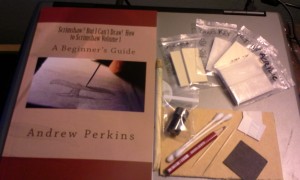
I’ve been scrimming for about six yrs now and I’m still learning. I just received your book, “Scrimshaw? But I can’t draw”, and Ron Newton’s “Learning How to Scrimshaw”. Still learning and getting better with each piece I do.
Fuzzy
Don’t know if we’ve ever met but have been doing scrimshaw full time for about 13 years. How can I get represented with a scrimshaw piece or link? Thanks, Terry C
Hey Terry,
don’t know if we’d responded to you yet, it’s been a little crazy here. Would love to add you to our growing list of scrimshaw artists. Send about three pics and a bio (approximate location – people ask for local artists to do custom work, we try to match them up as close as we can), how long you’ve been scrimming, your favorite media such as mammoth ivory, man-made materials, types of inks you prefer, your website if you have one, and your favorite subjects. We’ll put up a post and add a page with your name and information you’d like to share with other scrimshaw artists and collectors. Oops – forgot to tell you where to send the pics: aperkins[at]scrimshaw.com – just replace the [at] with the @ when you put the address in (posting it this way helps keep the ‘bots from sending me junk mail).
How small of pieces do you work on.
I have an Elk tooth I might want to have a little work
done on it?
Could you please tell me who does scrimshaw in stpaul mn.
I need to have a small piece done.
Thanks
jean
Hello Jean, and thanks for writing! I’m not sure who lives near St. Paul MN, but you may be able to find someone on our artists page (https://www.scrimshaw.com/scrimshaw-artists/). If anyone else knows of a scrimshaw artist in the area, please let us know, we’ll be glad to add them to our artists page as well!
My wife and I picked up a trinket box with beautiful engraving on top, sides and inside the lid. I thought it must be machine engraved because of the detail and precision. However, it has an artist signature and date. We are wondering if it is a true scrimshaw and, if so, who the artist is. It looks like Kovago. I have pictures of it and would love to uplaod them but the comments link doesn’t seem to include this function.
I too have a piece with the same artist signature and a date of 92. One side is a mermaid the other are dolphins. Found it in a shop in Niantic, CT in late 90’s. Do you know their value?
Thank you for including me in your scrimshander listing. Your site looks great and there is a ton of useful information. You have provided a link to my Etsy page which doesn’t have a lot of scrimshaw. My website, darrelmorris.finartstudioonline.com has more for your viewers to see. Either way, I appreciate being included here. Thank you.
Thanks Darrel! Love the front page! Will correct our site shortly.
I have two oval scrimshaw drawings with a backing of paper & the writing is with a quill pen which I believe the language to be French. One picture is of the Bonhomme, Richard and the other is of The Constitution. The wood surrounding the scrimshaw is black, very heavy, both in excellent condition except for the paper yellowing on the back. Are they of value is my question? Thank you for taking the time.
Hello Jacqueline,
we responded off of the site, but after thinking about it we wanted to add that many scrimshaw collectors as well as museums may be interested in your drawings as well. We could put up a couple of images of the artwork and see if there is any interest, we would just need any info you have, and we could have them reply to us, where we will forward the emails on to you.
Thanks for writing,
Andrew Perkins
I have bought 2-8×10 photos on scrimshaw at estate sale 1 of a man and woman and 1 of a lady looks like she is making sausage or something there is a 10cent sign on the 2nd one if anyone has any ideal who the artist is please email
Hi Robin, and thanks for writing! Sorry about the late response, it’s been a bit hectic here this spring. Are these photos etched into ivory? We’d love to see pictures if you can supply any and will be glad to post them. We’ve had some success finding both artists and information on them and would be glad to help.
i have been teaching scrimshaw at the jc campbell folk school and the wooden boat school for several years now. i am scheduled to teach at the wooden boat school in july but because of health problems its looking like i may not be able to follow thru. the people at wooden boat are great and i very much enjoyed teaching there. if anyone is interested in teaching please contact me and i will do what i can to make it happen for you and the school. tomorrow 3/1/13 i go under the knife so give me time to reply.
thanks
ron
Hope things went well, Ron. Anyone interested in helping the Wooden Boat School and teaching scrimshaw, please contact Ron at his email address.
I have 3 whale teeth given to me by my g. grandfather. the smaller one is raw 6 inches long and 4 inches wide. The middle one was scrimshawed with a ship on it and the large one is raw has “sandpaper scratches on it” but is 9 1/2 inches long and 4 1/2 inches wide. It weighs about 2 1/2 lbs. I would like to get the smaller and larger scrimshawed so I am interested in artist in the Florida area. It would be great to have ships or whaling scenes done on these. Any help would be appreciated.
I’ve just “approved” your inquiry, so hopefully an artist in your area would be able to help. You can also contact maritime museums in your state to see if they know of any reputable artists.
Hope this helps,
Andrew
Hi,
My father was an engineer on whaling ships in the late 50s / early 60s and I have a few tooth relics from his time at sea, one of which I believe to be absolutely unique – it is a hand carved figurine of a British character, Andy Capp. This character featured in the daily mirror for many years, first appearing around 1957. How would I go about getting a valuation on the little guy ?
Wow. I remember Andy Capp. Can you send several pics? I can contact some collectors, but they will want some high res. pics. Thanks for writing!
HI Andrew , Nice job on the site. you give a good overview, and this makes a great place for people to learn more about scrimshaw. BTW I love your iPhone cases! great idea.
Sandy
Thanks Sandy! I have been a fan of your work for many years. I am wondering how you are dealing with the recent California ban on ivory? I am thinking of retooling my kits to use some more eco-friendly alternatives. Also – is there an image you would like me to use on my Artists page for the link to your site?
I have started doing research to get immersed into Scrimshaw. Lining up books and videos to buy and locating material suppliers and so on. I do have one question. Evcerything I see is almost entirely a white base material (ivory, walrus tusk, mastadon, bone, antler, etc.) I would like to also explore the idea of scrimshaw onto things like black buffalo horn with a white pigment but haven’t seen anything like it yet. Is this possible or have folks found there are problems with this type of medium? Thanks for any information you may provide to someone looking to start into this fascinating, almost lost art form.
Chuck Parham
Hi Chuck, that’s a good question, and the answer is YES – you can (and people do) work on buffalo horn, as well as dark mammoth ivory and other dark materials, using light or white pigments. Popular with not only the blade forums (see http://scrimshaw.com/knife-forum-buffalo-horn-scrimshaw ), but on many other artistic items as well. Want a little creative brain candy? Click on this search on google (or other search engine – my link goes directly to the images) reverse scrimshaw. Many different ideas and a wellspring of creativity shows up. As I recall, some of the artists on the artists page have also done reverse scrimshaw, but I can’t bring one to mind at the moment, and it’s bed time for my little one. Hope this helps, and if I run into any step-by-steps, or if anyone knows of one, please comment it and I’ll check it and put it up for all interested parties.
Buffalo horn is a great material to work on. I use it quite a bit. For me it is best for images with a high level of contrast, but you can still achieve a high level of subtlety. Here are a couple of examples; http://darrelmorris.fineartstudioonline.com/workszoom/1201642
http://darrelmorris.fineartstudioonline.com/workszoom/1201643/nude-study-ii
Thanks Darrel! Used to live near a buffalo farm in N.Y., which as sadly become a golf course. Very smart animals, too. Haven’t had a chance to work on this material yet – how difficult is it to polish and work? I started on one cow horn and found it kind of “stringy”, yet I got another horn that is extremely smooth. Thanks for the link – it’s a great example of what can be done on what is a renewable material.
The horn that I use is water buffalo. It is easier to cut and polish than ivory, but it does burn easily. Its color runs from creamy white to black. Water buffalo horn has a slight grain, but not nearly as grainy as cow horn.
thank you for the opportunity to leave my question. I have two pieces of very nice scrimshaw,they are large ships one is the constitution and the other is the Bonhomme Richard and Serapis. I have had these for somr time and in all my searching I can not find the artists mark or any name or initials. my question is how can I post pictures of these on your site under mystery artist. CRL Scrimshander.
Dear Charles,
Thanks for inquiring. You may send the pictures to aperkins@scrimshaw.com, with “mystery artist” in the subject line. If you would, please indicate the state in which you purchased them, if you can remember, or the general whereabouts you acquired them, as this may help us track down the artist. We’ll be happy to add your pics to the “Mystery Artist” page! In fact, one of my favorite haunts, the engravers forum has a stunning example (http://engravingcafe.com/showthread.php?t=8158) by Darrel Morris.
Hi Andrew,
I really enjoyed looking through your site. I was wondering if you could add me to your Artists page? You can find examples of my work at:
http://michaelcohenscrimshaw.wordpress.com/
Thanks,
Michael
Sure thing, Michael! Glad to have you aboard! Picked one of your ships as an example, you may choose a different one if you’d like. You have quite a variety of designs – we should do an interview at some point so my viewers can get to know you better.
I do hope you recieved my comment it dissapeared & the page with it .Beautifull Iconic pieces of timeless art one can wear please help me view anything you may sell in jewery form & in meantime I`ll carry on the journey into History that makes the name “Scrimshaw”.
Hi Sara, and thanks for inquiring! Currently I don’t have many pieces in quantity, and I am slowly rebuilding my site after we outgrew our previous host. I can recommend Mark Thogerson very highly, as he is a prolific creator of many fine pieces of jewelry. Also one of my favorite artists would have to be Katherine Plumer, Sandra Brady, and there are many others – if you’d like to get overwhelmed, go to etsy.com and type in “scrimshaw” – you will find many fine artists there who work on mammoth, antler, paper micarta, corian and other materials. My initial site had many artists featured, and I hope to bring them back soon. Hope this helps, and please let me know if there is anything in particular you are looking for, since I am always up to a challenge when it comes to scrimshaw. One other artist you should see is Scot Kimel – the list goes on… Sincerely, Andrew Perkins
I love the concept & your beliefs on material sourcing. Iv`e seen some beautiful EXAMPLES adorning beautiful people in the form of jewelry pieces.I would love to own a piece ,how do I browse your (if indeed you produce in quantity) collections & any available catalogues?