Project: Fox in the Snow – Scrimshaw on Alternative Ivory

Along with testing alternative materials, I get to create pieces of art and refine my techniques. With Alternative Ivory, I’ve been working on a “Fox in the Snow” – a picture by Rob Lee on Flickr.com. This post will be updated and edited as I find interesting information and will pass along any tips and techniques as well.

As stated in the newsletter we found that coating the back of the image to be transferred with an aquarelle pencil then taping the piece to the back of the paper and using the “dot-to-dot” technique on the front pressed the pigment into the material without having to press hard enough to completely pierce the paper. This created smaller dots that were easily seen with magnification but could be ignored during the scrimshaw process and would not detract from the final image.

This is one of the few “furry” scrimshaw pieces I’ve done, mostly working with the more traditional ships and waves, lighthouses and flowers with the occasional loon done on commission. I’m a great fan of Katherine Plumer, who can capture dogs, cats, bears – you name it with such realism that I am in constant awe.  She created a piece with a dog and showed the progression, saving the eyes for last. I’ve got the eyes of the fox “sketched” in where I think they need to be but I’m also saving them for last. “Romeo” in progress, and “Romeo” finished shows a level of artistry and technique I hope to attain (it’s in my bucket list).

So, here’s the progress so far:
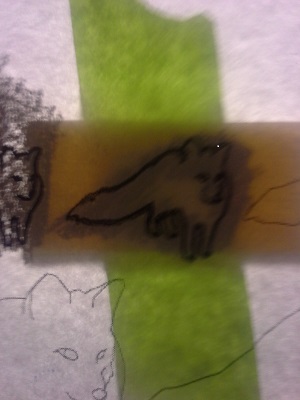
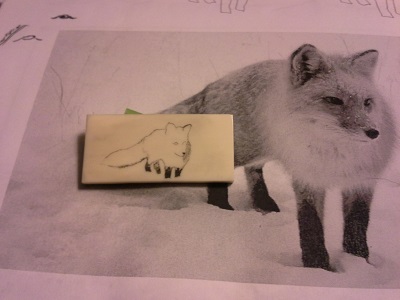
Picture of the fox printed on paper with the underside scribbled over with an aquarelle pencil, the alt ivory taped to the bottom with green masking tape.
The paper is on top, the back has been scribbled on with an aquarelle pencil. The alternative ivory is the next layer, then the tape. Picture taken with light behind the paper.
After removing the paper from the alternative ivory that had the underside coated by scribbleing with an aquarelle pencil, the dots are easily visible and not as deep.
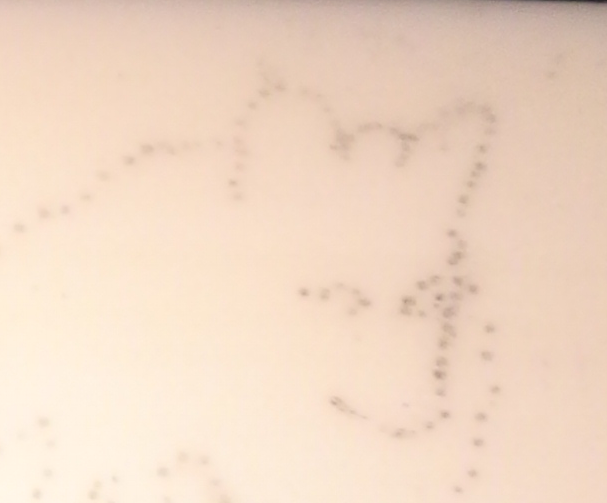
After creating the “stipple dots” with the pigment underneath, the dots are easily seen and the dots are much smaller.


Fox scrimshaw on alternative ivory - photo by Rob Lee on Flickr.com
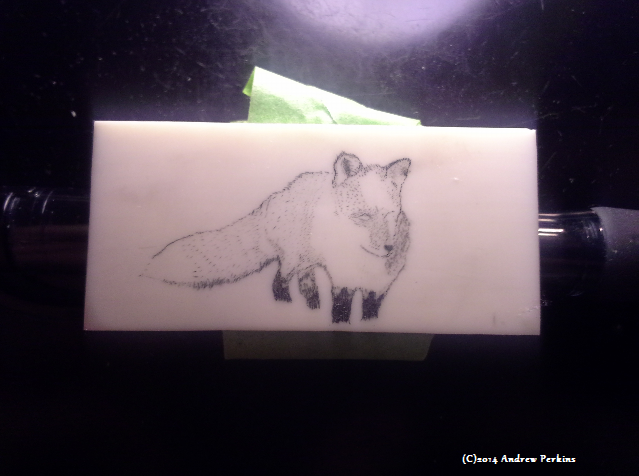
It’s cold in the snow, so I went ahead and put his boots on…
scrimshaw of a fox in the snow on alternative ivory in progress as of 2014-05-31
Filled in the darker fur and some of the ear details.
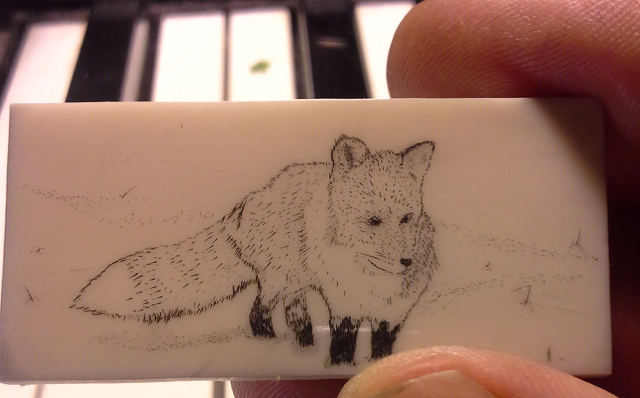
Fox in the snow in progress 2014-06-01
2014-06-01 Added the eyes and more detail, looked at the pic and realized it needs more shading

Scrimshaw for Young People

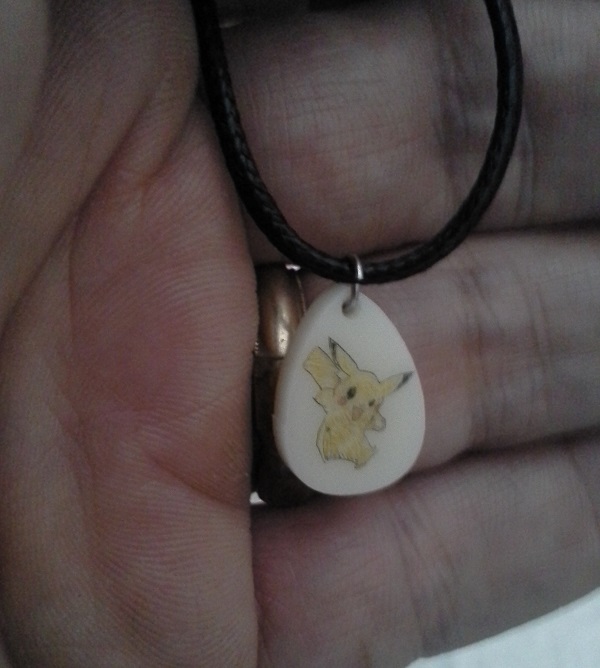
Picachu scrimshaw on acrylic teardropMy daughter wanted a Pokemon scrimshaw necklace. Figuring she would be wearing it onto the water, taking it off and leaving it someplace by accident, etc., I made it on a piece of white acrylic. This material has its challenges when it comes to coloring. Being a plastic, inks other than black tend to wash away very easily and don’t adhere in the scribed lines. So how do you make the pigment stay? My first solution was to let the ink dry completely then rub off the ink on the polished surface, which left very little ink on the body (the transparent yellow ink does not work well on acrylic, but works great on ivory, bone and tagau nut). The second solution worked, though: using a high quality artist’s colored pencil, I filled in the scribed lines again and wiped away the excess. The color stayed quite well, though just for safe measure I have since given it three coats of clear gloss spray varnish.
Since it’s acrylic, acrylic paint may work as well. Since she’d like another one, complete with each of it’s evolved variations (what have I gotten myself into?!), we’ll try some acrylic paint on the next one to see how that holds up. Oh yes… her friend’s birthday is coming up too…

Scrimshaw on Film

An interesting film on the art of scrimshaw. Only 11 minutes long, it’s professionally shot featuring Brian Kiracofe from Newport, Rhode Island. He tells the history of scrimshaw as he works on a miniature piece of scrimshaw.  He mentions his concern about the ivory ban well into it as well.

Identifying Ivory

I was set to create a long post about identifying ivory (there are many different types – just ask the tooth fairy) when I found this excellent pdf by CITES.org: http://www.cites.org/sites/default/files/eng/resources/pub/E-Ivory-guide.pdf.

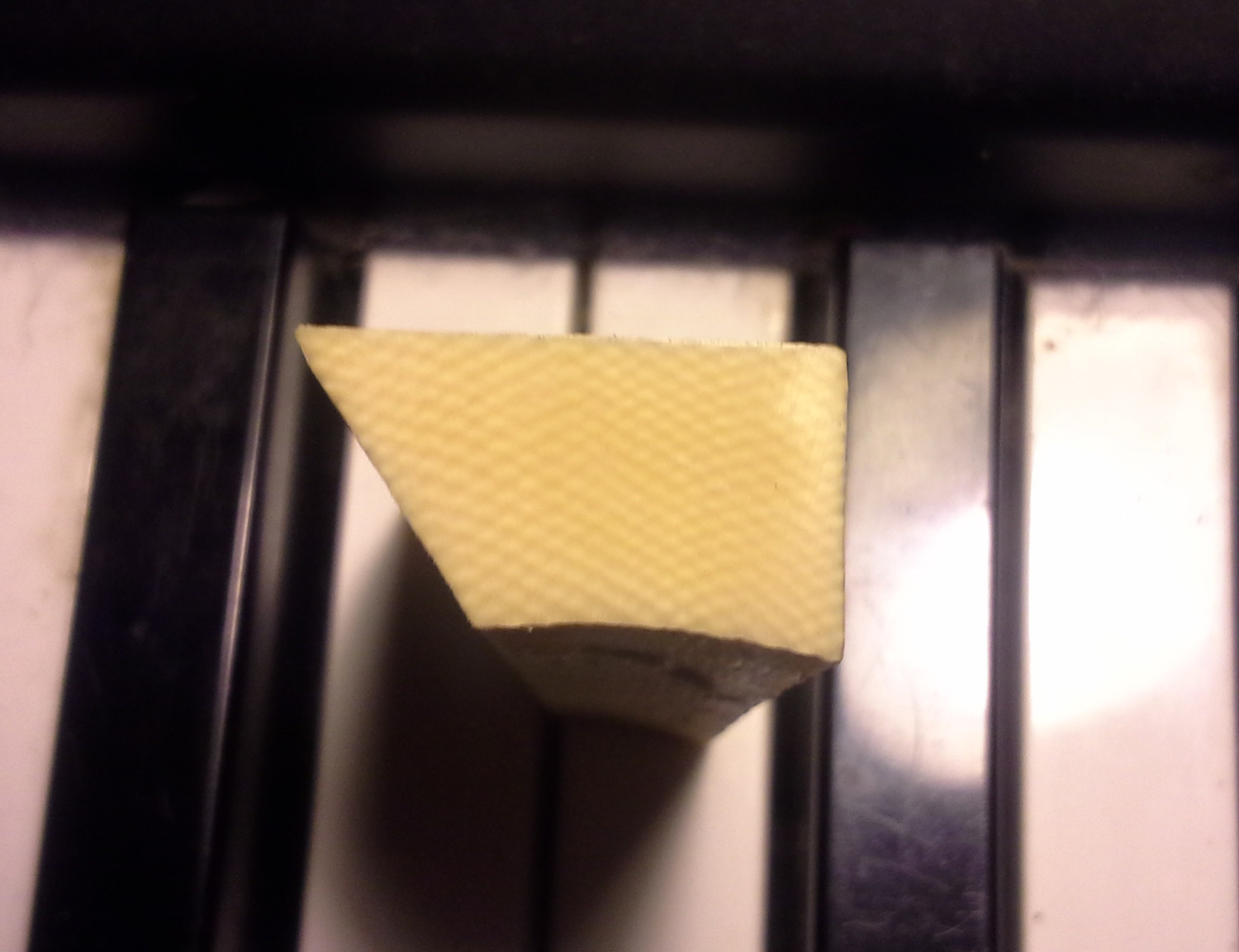
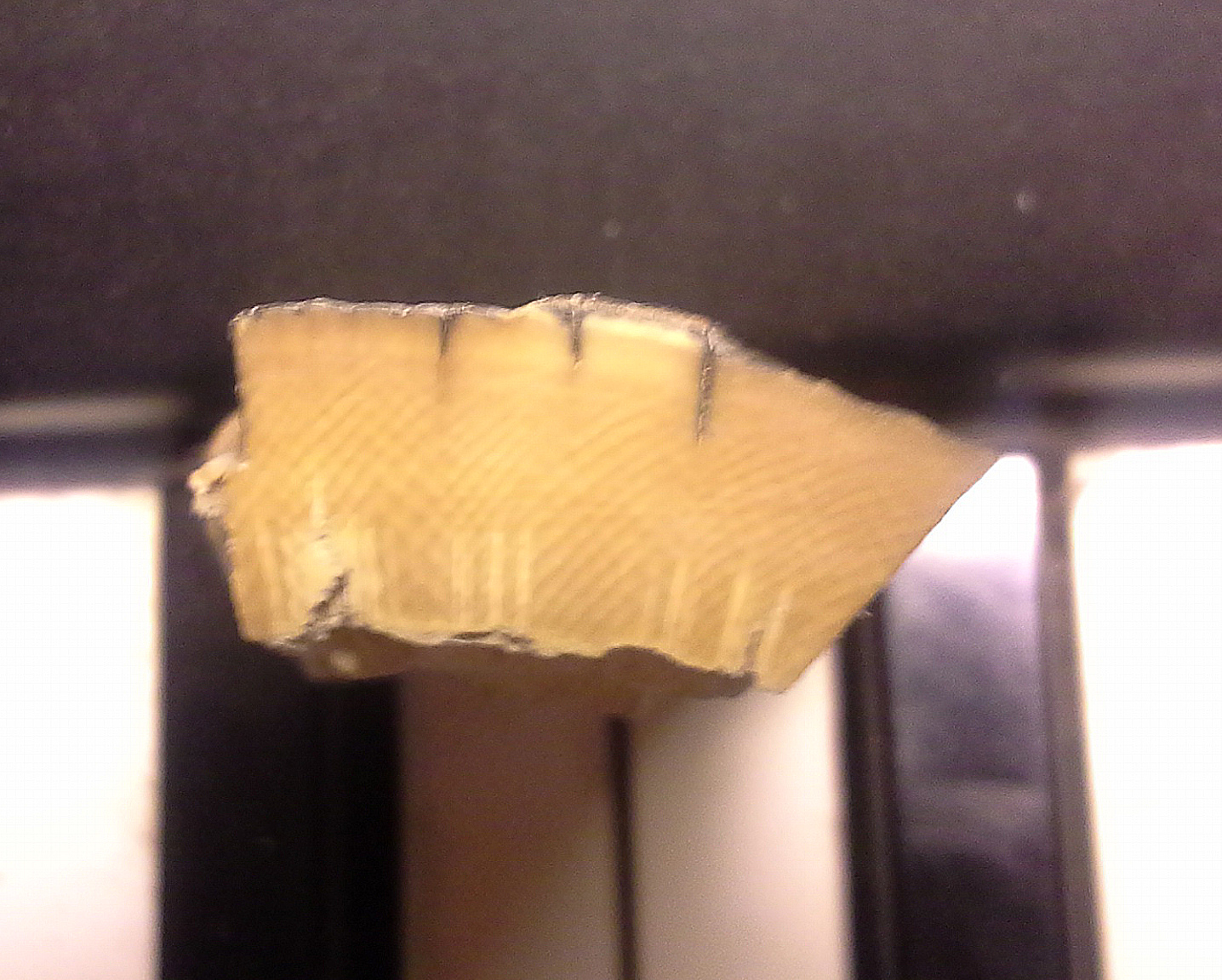
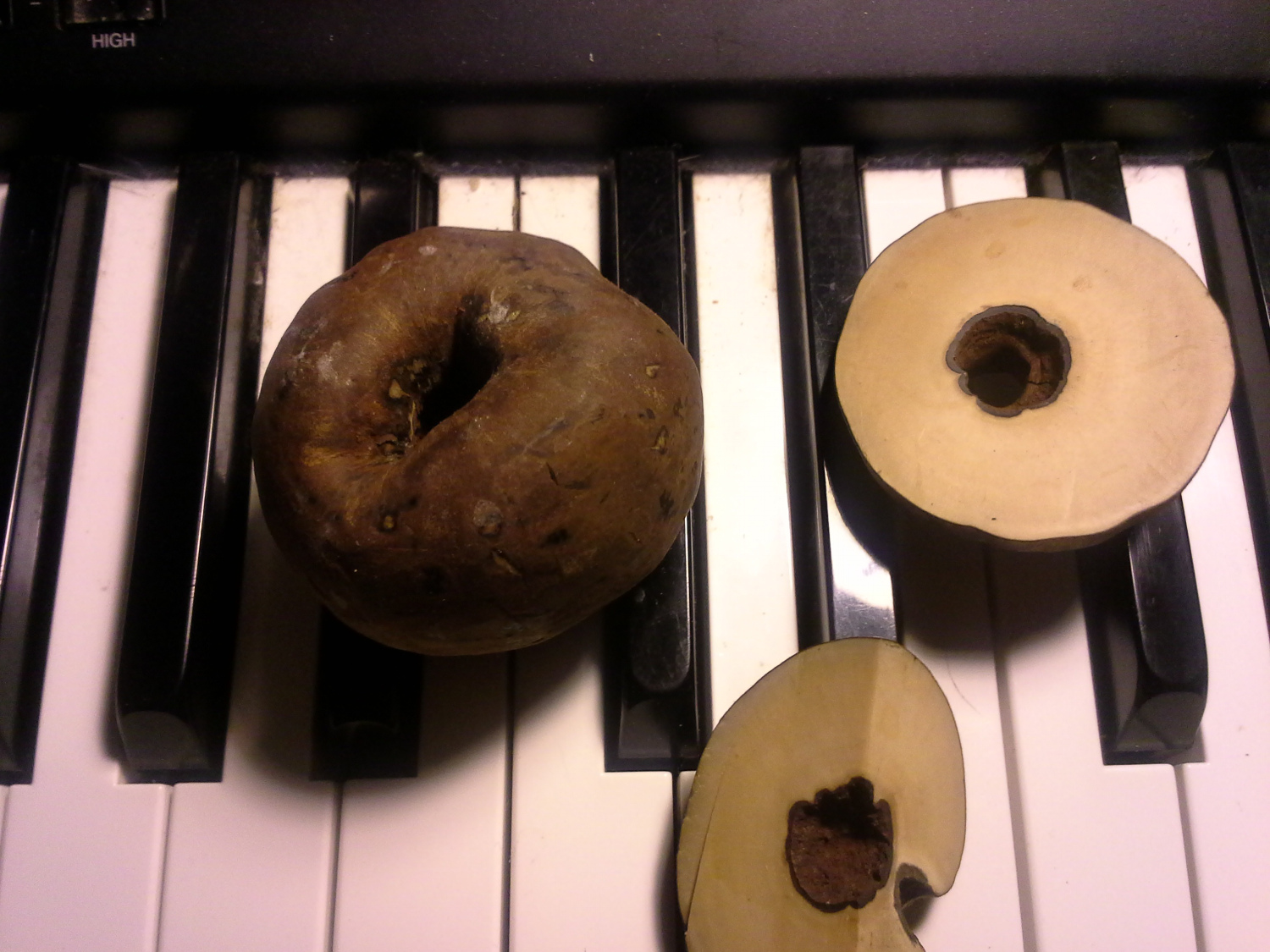
The pdf is in black and white. Here are a couple of full color examples of pre-embargo elephant ivory, mammoth ivory and a “vegetable ivory” cross-cuts showing the Schreger lines in the ivories and the lack of them in the plant alternative (clicking on the image brings it up to full size):

Elephant Ivory Chunk from pre-embargo ivory showing Schreger lines


Mammoth ivory showing Schreger lines
Mammoth ivory showing Schreger linesMammoth ivory


Ivory nut whole, halved and quartered


Scrimspirations – Illustrations to Scrimshaw and Other News

Scrimspirations – Illustrations to Scrimshaw and Other News

We’ve been busier at home than on the site throughout the winter which has finally left us. We’ve been busy creating illustrations, testing out alternative materials and doing too little scrimshawing.

Scrimspirations – Book 1 is a collection of photos with accompanying illustrations created especially for scrimshaw artists. Each photo comes with hand lined templates from 0.5″ up to 3.0″ so you can easily transfer the image to your material of choice.

Collage 7
Collage of current illustrations.

Some of the materials we’ve worked on include acrylic – an easy to use plastic that comes in many colors, “alternative ivory” – a molded polyester with a grain pattern, paper micarta, used most often as knife handles, casein – which is a plastic made from milk (we were able to get some from England where they stopped making it in the late ’70’s) and other materials.  We’ll be showing our findings here over the next several weeks.

There are laws they are attempting to pass that could impact the use and sale of ivory which are alarming not only to scrimshaw artists, but musicians as well.  In short, the previous laws passed to protect the whales was well thought out and measured. The laws they are currently debating, if passed, would make it very difficult if not impossible to re-enter the country with musical instruments which have ivory as their parts (such as guitars, violin bows, pianos, bagpipes and more) without being confiscated. read more here.

The New Bedford Whaling Museum will host the 26th annual Scrimshaw Weekend May 16-18. This internationally renowned event is the world’s only regular forum where collectors, dealers, curators, folk art and whaling history buffs share their interests in the indigenous art of whalers. see more at the New Bedford Whaling Museum.

Keep up on the posts by subscribing to our newsletter and get three patterns free!  We’re working out the bugs on this right now, and hope to have it automated soon.  Just look in the upper right-hand corner of the page.

Posted in FYI